 7.8/10
Web scraping and automation platform with a marketplace of ready-made scrapers (Actors), an API and usage-based pricing.


Web scraping API that handles proxies, JS rendering and CAPTCHAs, billed in credits that vary by target site.
We may earn a commission when you buy through our links. How this works
ScraperAPI suits developers and data teams who want to send a URL and get a page back without running proxies or headless browsers, especially for ordinary sites and ecommerce targets. If most of your volume is Google results, LinkedIn or Ultra Premium domains, work out the credit cost first, because that is where the bill grows quickly.
Best for: Developers and small data teams scraping public sites at steady volume
7.6/10 Good, with trade-offs. The overall score is our judgment against the questions we ask of every tool, not an average. How we score
| Question | Score | Why |
|---|---|---|
| Does the jobWhat it actually does for the task it is sold for, and where it falls short. | 8.0 | One call handles proxy rotation, retries, JS rendering and anti-bot bypass, with structured endpoints, async API and a crawler; only successful 200 and 404 responses are charged. |
| Ease of useSetup needed and how quickly you get something useful done. | 8.0 | GetApp reviewers rate ease of use 4.9 out of 5, citing quick setup and clear documentation, though it is a developer tool called from code. |
| Pricing and limitsWhat you pay at a realistic size, including caps, add-ons and deal limits. | 7.0 | Hobby is $49 for 100,000 credits, but Google costs 25 credits, so it covers 4,000 searches, and credits never roll over. |
| Reliability and supportUpdate pace, known problems and how support responds. | 7.5 | GetApp rates support 4.6 from 62 reviews and the vendor advertises 99.9% uptime, but priority support starts at the $975 plan. |
| Fit against alternativesHow it compares with the alternatives for the people it is aimed at. | 7.5 | Cost controls such as sa-credit-cost, a cost estimator and max_cost beat most; Apify or Bright Data suit ready-made scrapers or large proxy needs. |
ScraperAPI is a web scraping API. You send it a URL and an API key, and it returns the page as raw HTML or structured JSON after dealing with the parts that usually break a scraper: rotating proxies, headers, retries, CAPTCHAs and anti-bot checks. The company says it started in 2018 as a one-person project and now serves more than 10,000 brands, which is its own figure.
It is a developer tool. ScraperAPI offers a dashboard and a crawler UI, but the core product is an endpoint you call from code.
It suits developers, data teams and agencies who scrape public sites at steady volume for price monitoring, SEO data, lead lists or research, and who would rather pay per request than run proxy pools and headless browsers themselves. It is a good fit for ecommerce targets like Amazon, Walmart and eBay, which have their own credit rate and structured data endpoints.
Skip it if you need a no-code point-and-click scraper, or if your volume is mostly Google results or LinkedIn pages. Those take 25 and 30 credits per request, and the entry tiers run out fast. Also skip it if you were hoping an API would solve the legal side of scraping. It handles access, not permission.
The basic flow is simple: grab your API key, call the endpoint with the target URL, and add parameters as needed. The documentation covers four ways in:
Every plan includes JS rendering, premium proxies, JSON auto parsing, custom headers and sessions, desktop and mobile user agents, automatic retries and unlimited bandwidth. The vendor also advertises a 99.9% uptime guarantee. Useful controls include geotargeting by country code, sticky sessions, cached responses and a max_cost parameter that caps what a single request can spend. Each response carries an sa-credit-cost header, and a Domain Cost Estimator in the dashboard (or a urlcost API endpoint) tells you the price of a URL before you scrape it. The docs also list SDKs, LLM integrations and automation and workflow integrations.
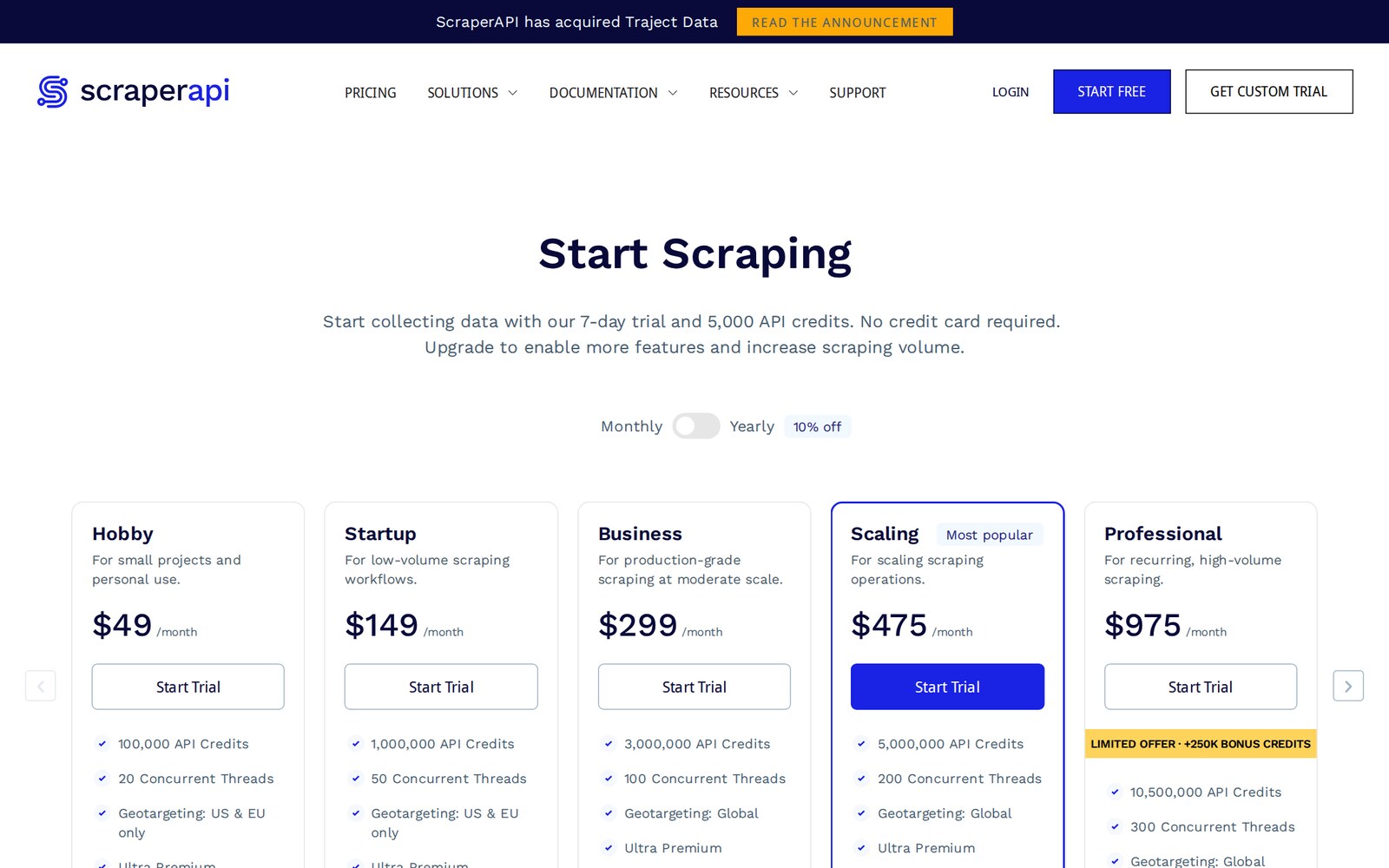
Prices checked 29 Oct 2026, in USD. The ScraperAPI free trial needs no card, and annual billing saves 10% on every self-serve tier.
| Plan | Monthly price | Billed annually | API credits a month | Concurrent threads | Notes |
|---|---|---|---|---|---|
| Free trial | $0 | n/a | 5,000 (7 days) | n/a | No credit card required |
| Free | $0 | n/a | 1,000 | 5 | Available after the trial |
| Hobby | $49 | $44.10/mo | 100,000 | 20 | US and EU geotargeting only |
| Startup | $149 | $134.10/mo | 1,000,000 | 50 | US and EU geotargeting only |
| Business | $299 | $269.10/mo | 3,000,000 | 100 | Country-level geotargeting, unlimited analytics history |
| Scaling | $475 | $427.50/mo | 5,000,000 | 200 | Pay-as-you-go available |
| Professional | $975 | $877.50/mo | 10,500,000 | 300 | Priority support, +250K bonus credits (limited offer) |
| Advanced | $1,975 | $1,777.50/mo | 21,500,000 | 500 | Priority routing, +500K bonus credits (limited offer) |
| Enterprise | Custom | Custom | 22,000,000+ | 500+ | Dedicated team, Slack support |
Credits do not roll over on any plan. When you run out, Hobby, Startup and Business pause until renewal unless you opt in to auto-upgrade, which moves you to the next plan. Scaling and above can also switch on pay-as-you-go at a fixed per-credit rate, up to a monthly cap you set. You can cancel from the dashboard with no cancellation fee, and the pricing FAQ promises a 7-day no-questions-asked refund.
This is the part to read before picking a tier, because ScraperAPI credits are not all equal. ScraperAPI charges 1 credit for a standard page. Amazon, Walmart and eBay cost 5, Google and Bing cost 25, and LinkedIn costs 30. Requests that need a Cloudflare, DataDome, PerimeterX or Akamai bypass cost 10 credits, and so do JS rendering, premium proxies and screenshots. Premium proxies plus rendering cost 25, and Ultra Premium costs 30, or 75 with rendering, on paid plans only. Geotargeting, sessions, device type and output format cost nothing extra.
So the $49 Hobby plan covers about 100,000 plain pages (roughly $0.49 per 1,000), 20,000 Amazon product pages, 10,000 rendered pages or 4,000 Google searches a month (about $12.25 per 1,000). On Startup, the same Google request works out at about $3.73 per 1,000. Failed requests are not charged; only 200 and 404 responses count. Going over your concurrency limit returns a 429 error rather than a bill. Protected and search targets are where it gets expensive, so check the credit costs for your own URL list first.
ScraperAPI holds 4.6 out of 5 from 62 GetApp reviews (Oct 2026), with ease of use at 4.9, value for money 4.5 and customer support 4.6. Reviewers mention quick setup, clear documentation and good results on difficult sites. The complaints are consistent too: some want credit rollover and cheaper premium features, and a few report slow responses, failed requests or trouble with specific sites. The Trustpilot profile shows mostly positive reviews, but Trustpilot notes the company has not invited reviews recently, so they may not be representative.
ScraperAPI is cloud-only, used through its API, dashboard and crawler UI, with code examples in cURL, Python, Node.js, PHP, Ruby and Java. The about page lists Zoltan Bettenbuk as CTO and dates the first version to 2018. The vendor says customers send 36 billion requests a month. Invoices, VAT numbers, payment methods, cancellation and account deletion are all handled in the dashboard, according to the docs. The pages checked do not list security certifications such as SOC 2.
ScraperAPI has acquired Traject Data, the company behind the Rainforest API and SerpWow API. A blog post dated 30 April 2026 says the deal closed a few months earlier and that existing service, pricing and API keys stay the same while Traject's structured data APIs move onto ScraperAPI's infrastructure. The current pricing also adds limited-time bonus credits to the Professional and Advanced plans.
Each alternative to ScraperAPI below does the same basic job. Compared to ScraperAPI, the differences are mostly in pricing model, ready-made scrapers and proxy access.
ScraperAPI does one job well: it turns a URL into usable HTML or JSON without you maintaining proxies or browsers, and the cost controls are better than most. I would use ScraperAPI for ecommerce and general site scraping at steady volume. For mostly Google or LinkedIn work, I would price the job against an alternative first, because the 25 and 30 credit rates change the maths a lot.
It fetches web pages for you through one API endpoint and handles proxy rotation, CAPTCHAs, retries and optional JavaScript rendering, then returns HTML or parsed JSON.
There is a 7-day trial with 5,000 API credits and no card required, then a free plan with 1,000 credits a month and 5 concurrent threads. Paid plans start at $49 a month.
A standard page costs 1 credit, Amazon, Walmart and eBay cost 5, Google and Bing cost 25 and LinkedIn costs 30. JS rendering, premium proxies and bot-protection bypass add to that.
No. The balance resets when the subscription renews, on every plan.
It depends on the site, the data and where you are. ScraperAPI handles access, not permission, so check the target site's terms and local data protection law, especially for personal data.
We may earn a commission when you buy through links on SaaSPic. It never changes our verdicts or the price you pay. Affiliate disclosure
Add this badge to your website so your visitors can read this independent review in one click.
 7.8/10
Web scraping and automation platform with a marketplace of ready-made scrapers (Actors), an API and usage-based pricing.
 7.4/10
Proxy network and web scraping API (Web API) for businesses that collect public web data at scale, on one credit-based plan.
 7.0/10
Belgian proxy provider selling residential, datacenter, ISP and mobile proxies plus a Google SERP API, with free proxy tools.
| Tool | Score | From | Free plan | Best for |
|---|---|---|---|---|
| ScraperAPI | 7.6/10 | $49/mo | Yes | Developers and small data teams scraping public sites at steady volume |
| Apify | 7.8/10 | $19/mo | Yes | Developers and data teams who scrape the web regularly |
| Oxylabs | 7.4/10 | $30/mo | No | Data teams running large scraping and price monitoring jobs |
| ProxyScrape | 7.0/10 | $9.50/mo | Yes | Developers and small data teams buying proxies for scraping and SERP tracking |
 8.4/10
AI coding agent with a desktop editor, CLI, cloud agents and code review that plans, writes and fixes code in your repositories.
 8.2/10
Cloud platform where Replit Agent builds, tests and publishes web and mobile apps with built-in hosting, database and auth.
 7.9/10
Virtualization software to run Windows, Linux and macOS VMs on a Mac, authorized by Microsoft for Windows 11 on Apple silicon.